
My brother Joshua was Valedictorian in his high school, and has a masters in computational linguistics. Alyssa has a PhD in chemical engineering. Needless to say, they are both smart cookies.
Josh and Alyssa chose to get married on March 14, at 1:59pm. If that time seems a little unusual, think about the symbol here.
After a beautiful sealing in the Oakland, California temple they had a reception and ring ceremony in Alameda, California.
I found it interesting that my Dad challenged them to have an even better marriage than their parents and that they would not be jealous.
Although Josh and Alyssa did have a small wedding cake, the dessert at the reception was pie.
They had fun dancing, and had prepared a waltz for their wedding, as well as some salsa dances.
It was a beautiful day and evening. I really do wish them a love that goes on forever. Constancy in their devotion to each other will be a key to understanding the mysteries of life. (Just like 'pi' helps understand the sciences and world around us!)
Some interesting tidbits about pi, from Wikipedia:

Pi or π is a mathematical constant whose value is the ratio of any circle's circumference to its diameter in Euclidean space; this is the same value as the ratio of a circle's area to the square of its radius. It is approximately equal to 3.14159 in the usual decimal notation. π is one of the most important mathematical and physical constants: many formulae from mathematics, science, and engineering involve π.[1]
π is an irrational number, which means that its value cannot be expressed exactly as a fraction m/n, where m and n are integers. Consequently, its decimal representation never ends or repeats. It is also a transcendental number, which means that no finite sequence of algebraic operations on integers (powers, roots, sums, etc.) can be equal to its value; proving this was a late achievement in mathematical history and a significant result of 19th century German mathematics. Throughout the history of mathematics, there has been much effort to determine π more accurately and to understand its nature; fascination with the number has even carried over into non-mathematical culture.
...
Furthermore, π is also transcendental, as was proven by Ferdinand von Lindemann in 1882. This means that there is no polynomial with rational coefficients of which π is a root.[10] An important consequence of the transcendence of π is the fact that it is not constructible. Because the coordinates of all points that can be constructed with compass and straightedge are constructible numbers, it is impossible to square the circle: that is, it is impossible to construct, using compass and straightedge alone, a square whose area is equal to the area of a given circle.[11] This is historically significant, for squaring a circle is one of the easily understood elementary geometry problems left to us from antiquity; many amateurs in modern times have attempted to solve each of these problems, and their efforts are sometimes ingenious, but in this case, doomed to failure: a fact not always understood by the amateur involved.
Physics
Although not a physical constant, π appears routinely in equations describing fundamental principles of the Universe, due in no small part to its relationship to the nature of the circle and, correspondingly, spherical coordinate systems. Using units such as Planck units can sometimes eliminate π from formulae.


- Coulomb's law for the electric force, describing the force between two electric charges (q1 and q2) separated by distance r:[59]


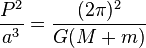
- Kepler's third law constant, relating the orbital period (P) and the semimajor axis (a) to the masses (M and m) of two co-orbiting bodies:
-
Open questions
The most pressing open question about π is whether it is a normal number—whether any digit block occurs in the expansion of π just as often as one would statistically expect if the digits had been produced completely "randomly", and that this is true in every base, not just base 10.[48] Current knowledge on this point is very weak; e.g., it is not even known which of the digits 0,…,9 occur infinitely often in the decimal expansion of π.[49]


2 comments:
Whatever on Pi. Can you post some more of the wedding photos? I haven't seen any yet.
Pi is not the only irrational constant in the universe, just the most common. Can't calculate much about the world without Pi. Can't understand much about love without a partner. Even if that partner is often irrational.
Post a Comment